
There are many natural wonders in the universe. Start with the sheer size — estimates of the total number of galaxies range from 200 billion to two trillion, with each galaxy containing anywhere from 100 million to 400 billion stars.
And then there are the mysteries. Just what are dark matter and dark energy? How big can a black hole get? What exactly is a quasar?
Let me add something else to think about — could there be dinosaur fossils on the moon?
If an asteroid large enough to cause a mass extinction really did hit earth 65 million years ago, it would’ve kicked up a huge amount of debris. Some of that debris would’ve been ejected into space. And it’s plausable that some of the ejecta would’ve been captured by the moon’s gravity, and ultimately ended up on the moon’s surface.
What would’ve been in that debris? Lots of rock. And since, according to the fossil records, dinosaurs had already occupied Earth for roughly 200 million years, there’s a good chance some of that rock would contain fossils, including dinosaurs!
Unlikely? Yes, but entirely possible. Remember, a SpaceX rocket recently collided with the moon. And some have hypothesized that fossils of microbial life on Mars may have ended up here the same way, although nothing has been proven yet. (First we have to prove that there really was life on Mars, https://www.sciencenewstoday.org/evidence-of-life-on-mars-what-have-we-actually-found-so-far). Anyway, thoughts like these are really mind-blowing.
Of course, I didn’t think of this myself. This is just one idea advanced in an article on the EarthSky website, appropriately titled “9 Mind-Blowing Space Facts That Will Shock You.” (https://earthsky.org/space/9-mind-blowing-space-facts/)
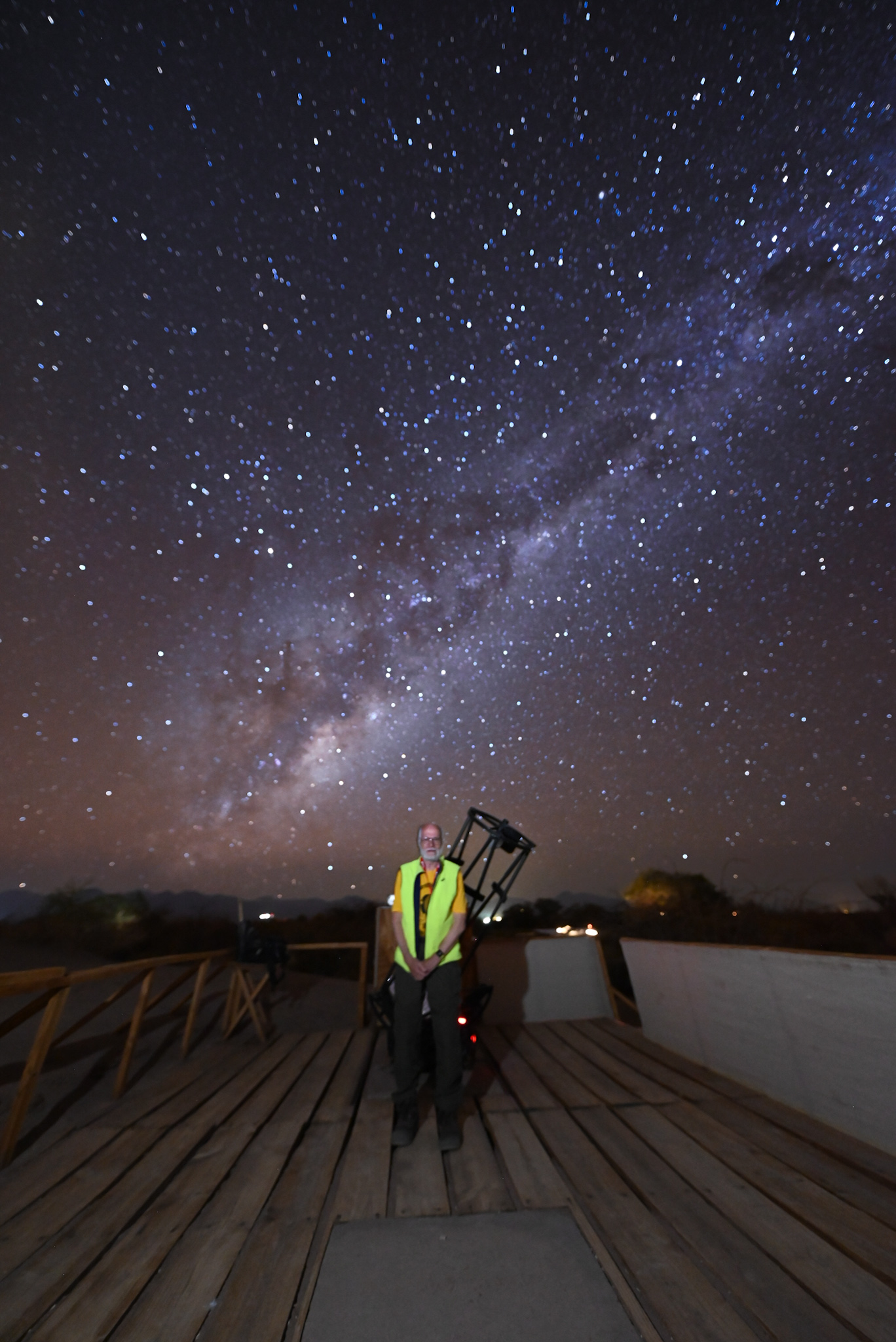
And speaking of mind-blowing facts, the photo is me with the Milky Way as seen from the Southern Hemisphere. It was taken at an observatory in the Atacama Desert of Chile in April 2025.