
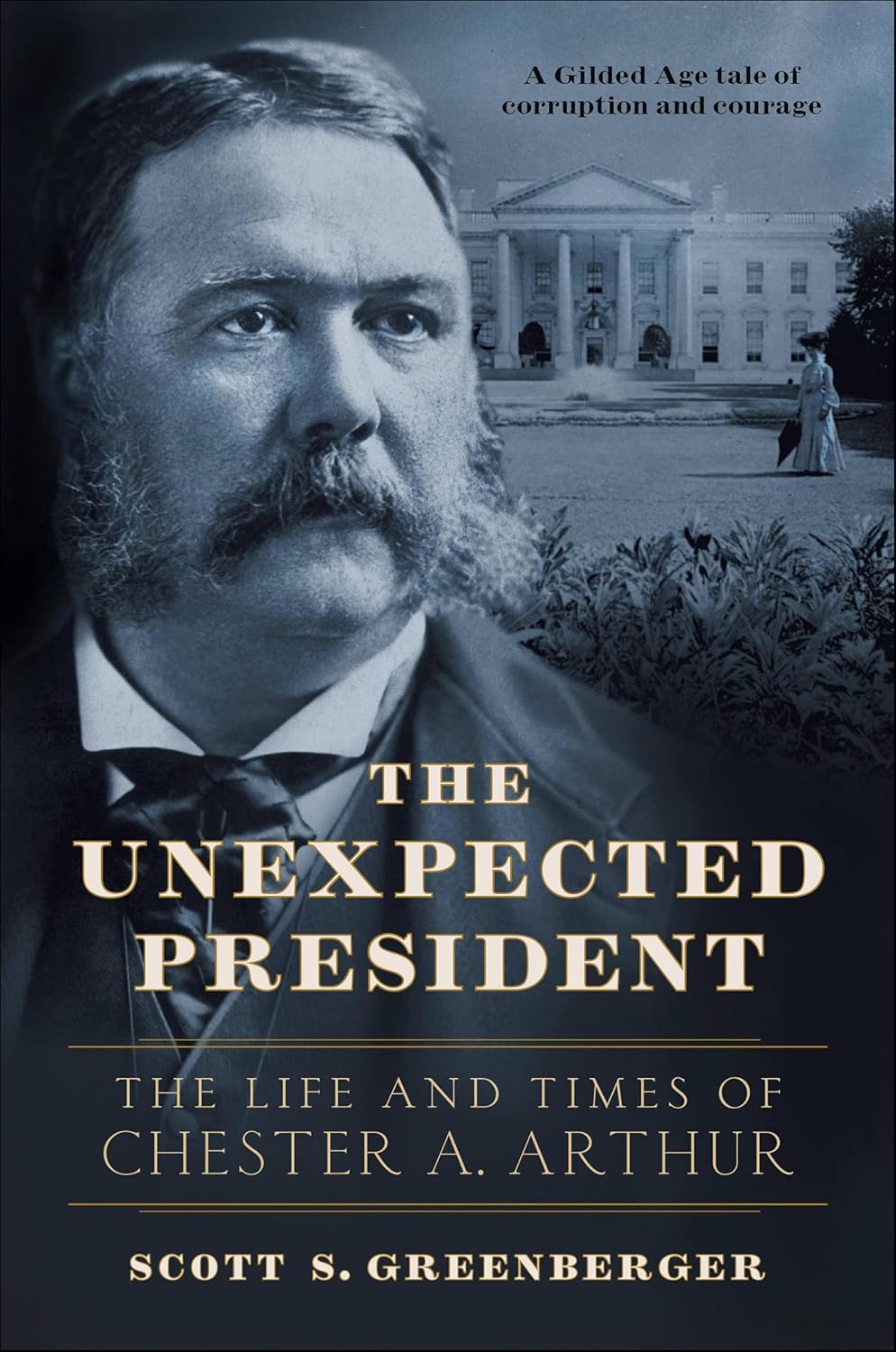
Do you recognize the name Chester Arthur?
I hope you do, because he was one of our presidents. His story is being told in the biography The Unexpected President by Scott S. Greenberger.
Why the title? This part of his life was completely unexpected.
The historical context begins with the presidency of Ulysses S. Grant (1869 to 1877), which had been stained by corruption as many of the people Grant had entrusted with government jobs had betrayed that trust. Such was the tenor of the times, but a promising reform movement was begun by President Rutherford B. Hayes (1877 to 1881). Hopes were high that Hayes’s successor, James A. Garfield, would continue the much-needed governmental makeover. For the sake of geographical balance and party unity, Chester Arthur, a New York machine politician beholden to others for his career, was added to the ticket as vice president. (This was somewhat similar to the William Henry Harrison & John Tyler pairing in 1841).
But on July 2, 1881, Garfield was shot in the Baltimore and Potomac Railroad Station in Washington, D.C., He had been president less than four months. He initially survived the attack, but finally succumbed to his wounds on September 19, 1881. (https://en.wikipedia.org/wiki/Assassination_of_James_A._Garfield).
To say Arthur was in a difficult position was the understatement of the 19th century. He never sought nor expected to be president, had no real political base of support, and some blamed him for being the assassin’s inspiration.
And yet Arthur grew into the office. He confounded critics by bypassing the machine of his political heritage and had some solid accomplishments, like modernizing the U.S. Navy and signing Pendleton Civil Service Reform Act of 1883.
However, he did not aggressively campaign for the Republican Party’s nomination in 1884, getting bypassed by Speaker of the House James G. Blaine of Maine (who lost anyway to Grover Cleveland).
Why? Arthur realized his health was failing. He died 20 months after leaving office, on November 18, 1886 at the age of 57. Just before he died, he ordered nearly all his papers burned, another reason for his anonymity.
Biographer Scott S. Greenberger does an excellent job of bringing his subject to life. He provides important context and his writing style pulls the reader along and builds interest. At times, it was almost like reading a novel.
And I hope you’ve at least heard of Chester Arthur.