
When you’re planning a camping trip and buy a bear-resistant cooler, how do you know it’s really bear resistant?
It is if it’s been tested by a bear.
Yes, bears really do test the products. Take the case of a grizzly bear mother and her three cubs that were serious problems, feasting on a rancher’s free-range chickens. The usual solution is to shoot them, which the rancher did to the mother and one cub. But the other two cubs were transported to the Grizzly & Wolf Discovery Center in West Yellowstone, Montana (https://www.grizzlydiscoveryctr.org/). Here they were put to work for mutual benefit — testing camping products to ensure they really are bear-proof. (To see them at work, look for “Product Testing” in the website menu.)
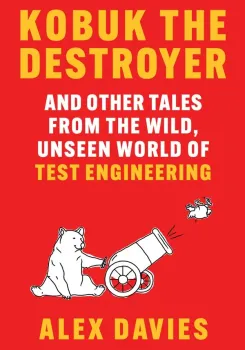
This very helpful but behind-the-scenes role is now getting publicity, thanks to a new book, Kobuk the Destroyer And Other Tales from the Wild, Unseen World of Test Engineering (https://bookshop.org/p/books/kobuk-the-destroyer-and-other-tales-from-the-wild-unseen-world-of-test-engineering-alex-davies/0d5376eeedd8c2b2?). The two cubs, named Kobuk and Nakina after rivers in British Columbia and Alaska, are not only living their lives in safety, they are earning their keep. A book excerpt is at https://www.sciencefriday.com/articles/kobuk-the-destroyer-book-excerpt/
This is one example of ways animals can help us beyond the usual medical research and product testing. In fact, I have some personal experience in this area. Do you remember the Miracle on the Hudson, when an airliner was forced down into the Hudson River because a flock of birds disabled its engines (https://en.wikipedia.org/wiki/US_Airways_Flight_1549)?
One of my Air Force tours was as the on-site manufacturing officer for the B-1 bomber engines. Bird strikes are such a major problem that engines are actually tested for durability by firing real birds (dead, of course) into a running engine. In this case, two scenarios were tested — a flock of small birds (I don’t remember how many) were sequentially fired at several points in the intake to see if the engine could recover, and a five-pound goose was used to determine if the damage would be contained. Remember, if the damage is severe enough to disable the engine, at least you want containment so multiple engine parts don’t come flying toward the fuselage at high speed. I especially recall the goose test. The engine did stop running (as was expected), and the containment… Well, let’s just say there was a design change.