
Today it’s Elon Musk, Warren Buffet, Bill Gates, and Mark Zuckerberg. But in an earlier time it was Henry Ford, John D. Rockefeller, JP Morgan, and Andrew Carnegie.
I became interested in this “earlier time” when I assisted with a social-studies class in the high school that was exploring this era. So I decided to do some research myself.
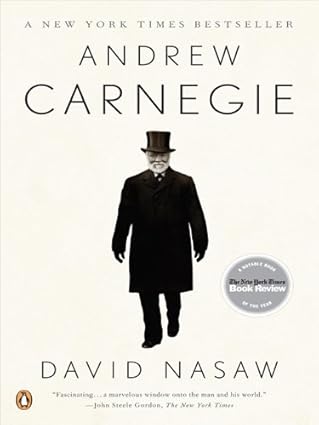
I started with Andrew Carnegie by David Nasaw because of the direct comparison of his philanthropy with the modern charity work of Warren Buffet and Bill Gates.
Carnegie was a Scottish immigrant who was ambitious and unafraid to take chances. For example, he learned Morse Code, which got him an entre into the railroad business. He found opportunities in railroads, oil, bridge-building and other ventures, investing in companies and living off the dividends. Of course, his greatest success came later in steel-making. He was not a good frontline supervisor, but he was able to find skilled managers to run his companies for him. He became so successful at this strategy that he semiretired in his late 30s, spending much of the year away from work and traveling, especially back to his beloved Scotland. The telegraph and transatlantic cables became important business tools.
He developed a philosophy that his duty was to make as much money as possible so he could give it away. Unfortunately, to accomplish this, there were times when workers in the factories he owned were toiling twelve hours a day, seven days a week. (Perhaps it was what the competition dictated.) He claimed to be sympatric to the working class, yet did everything he could to prevent union representation. This led to one bitter strike which turned violent. Fortunately for him, he was out of the country at the time.
His later ambition was to be known as a man of letters, self-publishing a number of books and regularly contributing to newspapers and other periodicals. His wealth gave him access to men of power, especially U.S. presidents and British prime ministers. He never hesitated to offer his advice, which was not always welcome.
When he sold his steel company (the basis of the modern U.S. Steel) he was the richest man in the country. Despite his best charitable efforts — funding libraries, church organs, New York’s Carnegie Hall to name a few causes — he soon realized he was making money faster than he could give it away, necessitating the establishment of a foundation to manage what was left.
His final cause was world peace, and the failure which became the carnage of World War I caused him so much distress that it probably contributed to his death in August 1919 at the age of 83.
David Nasaw’s treatment was well-written and detailed. However, I was disappointed by a lack of photographs and an Epilogue to explain the ultimate fates of his wife and daughter (he had married late in life, after his mother had died), and to summarize his accomplishments and impact.
By the way, I’m reading about Henry Ford now.